Interventional Endocrinology · San Diego
Interventional endocrinology uses percutaneous, image-guided procedures to treat endocrine disease in the office, under local anesthesia — no incision, no general anesthesia, and no hospital stay. The most established of these techniques are radiofrequency ablation (RFA) and ethanol ablation of benign thyroid nodules. This page explains how they work, who they help, what they cost, and the real outcomes from our own practice.
118 consecutive patients, six-month results — presented at ENDO 2026.
The most established interventional procedures for the thyroid are radiofrequency ablation (RFA) and ethanol ablation of selected benign nodules, along with treatment of certain other neck lesions. Each works differently and suits a different problem, but they share the same goal: to relieve symptoms and treat disease while sparing healthy tissue and avoiding the risks of an operation.
A thyroid nodule is a growth of thyroid tissue, or a fluid-filled cyst, that forms within the gland. They are extremely common — the majority of people develop one during their lifetime, most without ever knowing. Most need no treatment at all. Intervention is considered when a nodule grows large enough to interfere with breathing or swallowing, produces too much hormone, or causes a visible or cosmetic concern. For many years, surgery or radioactive iodine were the only options for a nodule causing problems. Image-guided ablation has changed that.
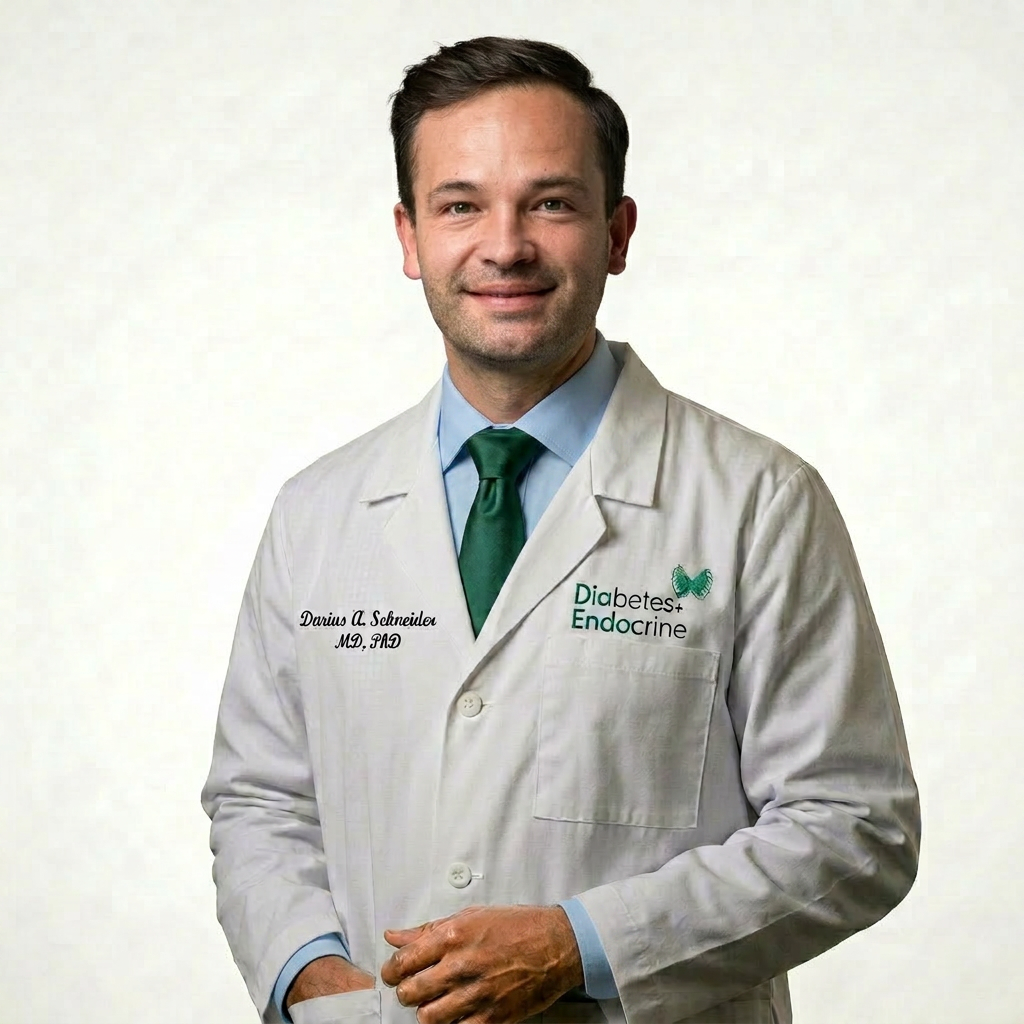
These procedures demand specialized training to perform safely and well. Dr. Schneider was trained in ultrasound-guided interventional techniques in Frankfurt, Germany, and combines that training with clinical thyroidology and diagnostic ultrasonography. Determining whether ablation is right for a given patient is a multidisciplinary decision — we work closely with head and neck surgeons, nuclear medicine physicians, and radiologists when evaluating candidacy.
We are Diabetes and Endocrine Specialists — San Diego's innovative endocrinology practice, with offices in La Jolla, Poway, and La Mesa. Our physicians trained at leading academic centers, conduct clinical research, and have presented at national and international meetings. This site is the interventional arm of that practice: image-guided, gland-preserving procedures for thyroid and parathyroid disease.
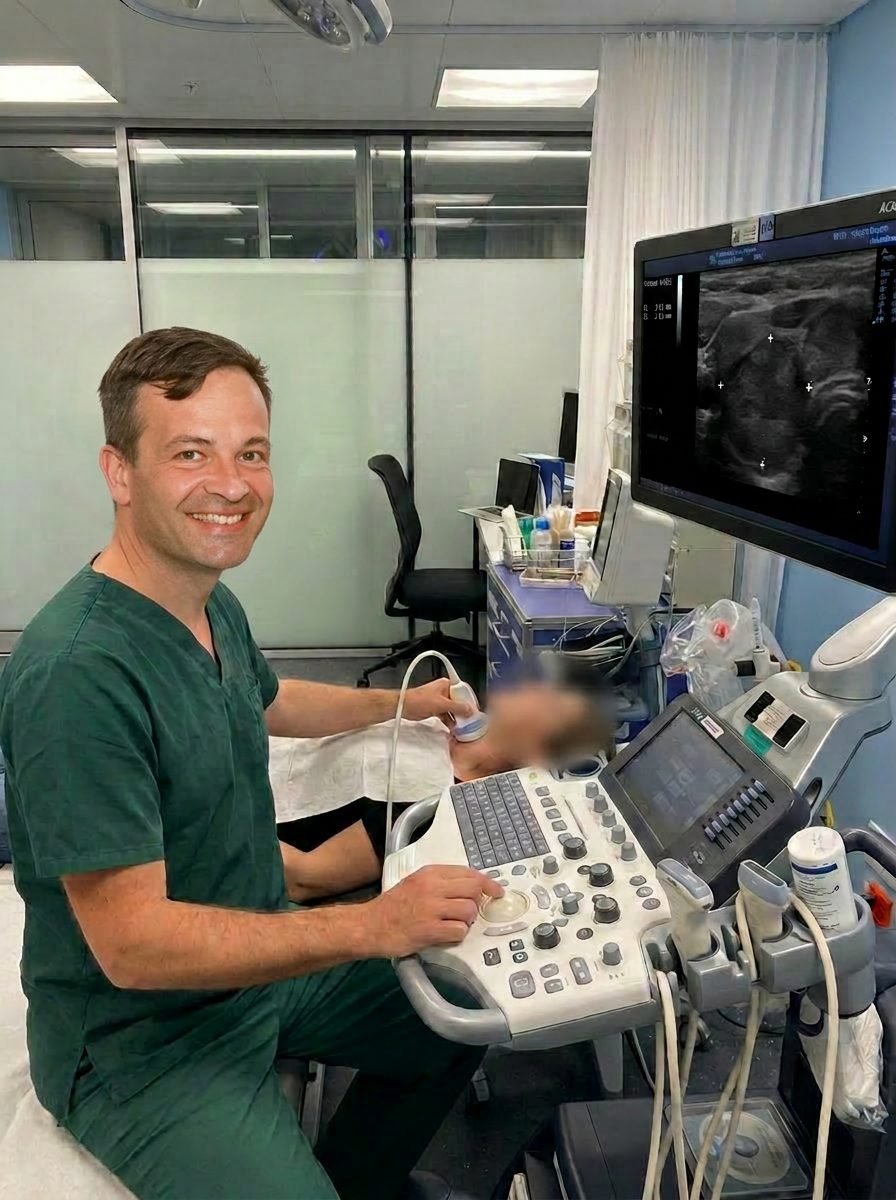
Thyroid radiofrequency ablation is led by Dr. Schneider, who trained in ultrasound-guided interventional techniques in Frankfurt, Germany, and combines that training with decades of clinical thyroidology and diagnostic ultrasonography. Our RFA program was selected for oral and poster presentation at ENDO 2026. Explore our clinical research.
Most practices refer thyroid nodules out for surgery. We treat them in the office, through the skin, without an incision or general anesthesia.
Among the first practices in San Diego to offer ultrasound-guided thyroid nodule ablation (RFA and ethanol), in-office and under local anesthesia.
Fellowship-level expertise in thyroid ultrasound and ablation, with technique drawn directly from the international literature.
118 consecutive patients, 75% mean volume reduction, zero major complications — presented at ENDO 2026, not borrowed from overseas centers.
A thyroid nodule is a growth of thyroid tissue, or a fluid-filled cyst, that forms within the gland. They are extremely common — most people develop one during their lifetime, usually without ever knowing.
The great majority of nodules are benign and need no treatment at all. Intervention is considered only when a nodule grows large enough to interfere with breathing or swallowing, produces too much thyroid hormone, or causes a visible or cosmetic concern. For nodules that do cause problems, image-guided ablation now offers a gland-preserving alternative to surgery or radioactive iodine.
Cystic, fluid-filled nodules are very common and very rarely cancerous. They can often be drained with a needle, but the fluid frequently re-accumulates and the nodule returns.
Because simple aspiration is so often temporary, a durable solution targets the lining that produces the fluid. Ethanol sclerotherapy does exactly that, and mixed cystic–solid nodules also respond especially well to RFA after the fluid is drained. In our own cohort, mixed cystic–solid nodules shrank by a mean of 85.8% — more than predominantly solid nodules. See Ethanol Sclerotherapy and RFA.
Standard RFA and ethanol ablation are for nodules confirmed benign on biopsy. They are not a primary treatment for thyroid cancer. For an enlarged thyroid, see goiter treatment options.
If a nodule shows suspicious or malignant cytology, the right path is a multidisciplinary discussion with head and neck surgery — care we coordinate through Diabetes and Endocrine Specialists. In carefully selected patients who are not surgical candidates, ablation of certain recurrent or low-risk cancers may be considered on an off-label basis; see RFA for Thyroid Cancer.
Every candidate is evaluated the same way before any ablation is scheduled: high-resolution ultrasound and, where indicated, a needle biopsy. How we decide whether a nodule needs a biopsy.
High-resolution neck ultrasound characterizes the nodule's size, composition, and relationship to surrounding structures, and measures baseline volume.
Cytology confirms the nodule is benign (Bethesda II). RFA is appropriate only for nodules confirmed benign — not for suspicious or indeterminate results.
Thyroid function tests identify autonomously functioning ("hot") nodules and establish a baseline for follow-up.
Radiofrequency ablation uses a thin, internally cooled electrode, placed through the skin under continuous ultrasound guidance, to deliver heat directly into a thyroid nodule. The heat destroys the nodule tissue, and over the following weeks and months the body gradually clears it away, so the nodule shrinks.
RFA does not cut the nodule out. Instead of removing thyroid tissue surgically, it treats the nodule in place and leaves the surrounding healthy thyroid untouched. That is the central difference from an operation, and it is why most people keep normal thyroid function afterward and avoid a lifelong thyroid hormone pill.
RFA is well established. It has been a routine treatment for benign thyroid nodules for years in high-volume centers internationally, particularly in South Korea and parts of Europe, where published series report durable volume reduction of roughly 80–90% beyond three years after a single session, with low regrowth and very low rates of serious complications. In the United States, adoption began in academic centers and is now reaching community practice — which is where our own experience comes in.
The technique we use is the trans-isthmic moving-shot approach under real-time ultrasound — the same method described in the international literature. Here is what actually happens during a treatment.
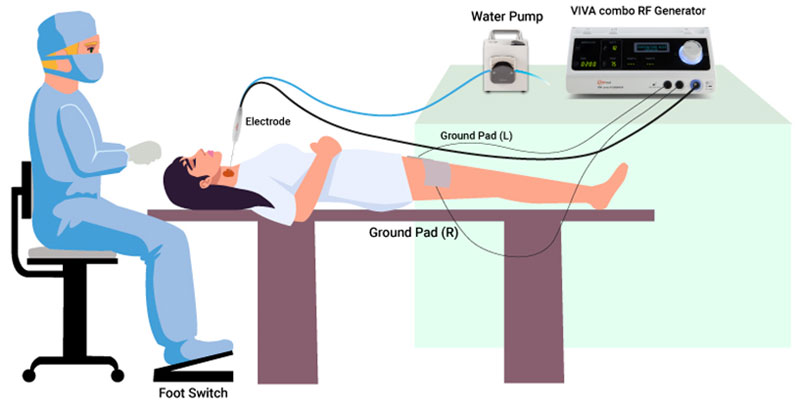
After written consent, the front of the neck is numbed with lidocaine and epinephrine. You stay awake and comfortable throughout — there is no general anesthesia and no breathing tube.
Under continuous ultrasound, the RFA electrode is advanced toward the nodule using a trans-isthmic approach — entering across the isthmus so the needle path stays controlled and away from critical structures.
Radiofrequency energy is delivered in small, controlled zones, moving through the nodule until all safely accessible parts have been treated — rather than heating a single fixed spot.
If a nodule has a large fluid (cystic) component, the fluid is drained with a fine cannula under ultrasound immediately before ablation, so the solid wall can then be treated effectively.
Equipment. We use an internally cooled monopolar RFA electrode (RF Medical ThyBlate, 18-gauge, 10 mm active tip). The procedure is performed in the office; most patients go home the same day and return to normal activity quickly.
RFA is offered to patients whose nodule has been confirmed benign and is symptomatic or cosmetically bothersome. It is not a treatment for thyroid cancer. Candidacy is confirmed with ultrasound and a biopsy before any ablation is scheduled.
A feeling of pressure or fullness, difficulty swallowing, frequent throat-clearing, or the sensation of a lump (globus) caused by a benign nodule pressing on nearby structures.
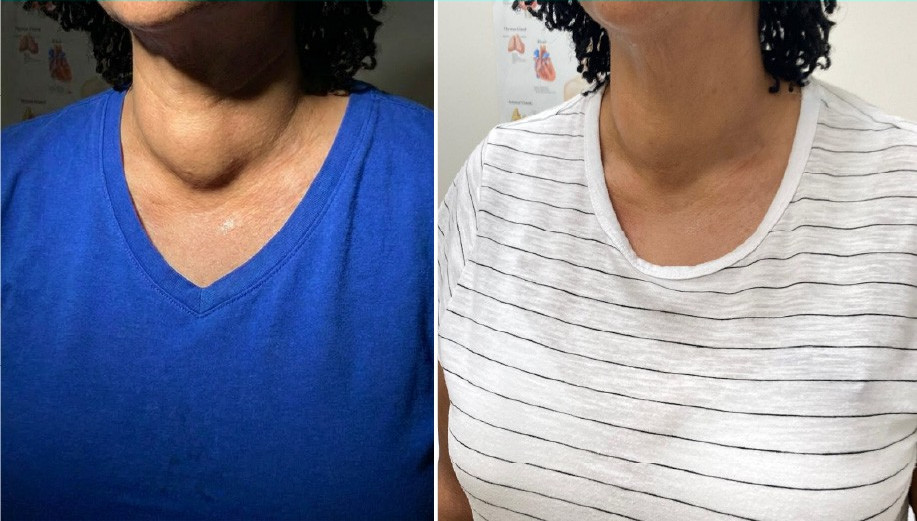
A nodule large enough to be seen or felt in the neck. Shrinking it improves the neck contour without leaving a surgical scar.
Recurrent thyroid cysts, and selected autonomously functioning ("hot") nodules that overproduce thyroid hormone, can also be candidates in appropriately evaluated patients.
Important: RFA is only appropriate after a nodule is confirmed benign on biopsy (Bethesda II cytology). It is not a treatment for thyroid cancer or for nodules with suspicious or indeterminate cytology. Every candidate is evaluated individually; not every nodule is suitable for ablation.
For a benign nodule, surgery (removing part or all of the thyroid) and RFA both relieve symptoms — but they get there very differently. RFA is a gland-preserving alternative that avoids the main downsides of an operation.
| Radiofrequency ablation | Thyroid surgery | |
|---|---|---|
| Incision & scar | None — needle through the skin | Neck incision and permanent scar |
| Anesthesia | Local only, awake | General anesthesia |
| Hospital stay | None — outpatient, home same day | Often overnight or day-surgery admission |
| Thyroid function | Preserved in nearly all patients | Lobectomy or total removal can require lifelong thyroid hormone |
| The nodule | Shrinks over months; tissue stays in place | Removed entirely |
| Recovery | Quick — back to normal activity fast | Surgical recovery period |
| Repeatable | Can be repeated if needed | Re-operation is more complex |
An estimated 30,000–50,000 U.S. patients undergo surgery each year for benign thyroid disease. RFA offers a gland-preserving alternative that avoids general anesthesia, cervical scarring, hospitalization, and the long-term consequences of removing the thyroid — extending treatment to patients who decline surgery or cannot safely undergo it.
Most RFA information online comes from large overseas academic centers. The data below is ours — 118 consecutive patients with cytologically benign nodules, treated in a community endocrine practice and presented at ENDO 2026. These are six-month outcomes; longer-term follow-up is ongoing.
101 of 118 patients reached a favorable response; 33 of 118 reached near-complete ablation. All patients were symptomatic at baseline; 71 had complete resolution of their presenting symptoms by six months, with substantial improvement in nearly all others.
| Nodule type | N | Baseline volume | Mean VRR |
|---|---|---|---|
| Solid / predominantly solid | 95 | 15.6 mL | 71.4% |
| Mixed cystic–solid | 23 | 45.6 mL | 85.8% |
| Overall cohort | 118 | 21.4 mL | 75.0% |
Mixed cystic–solid nodules responded better than predominantly solid nodules (85.8% vs 71.4% mean VRR, p < 0.05). Cystic components were drained immediately before ablation.
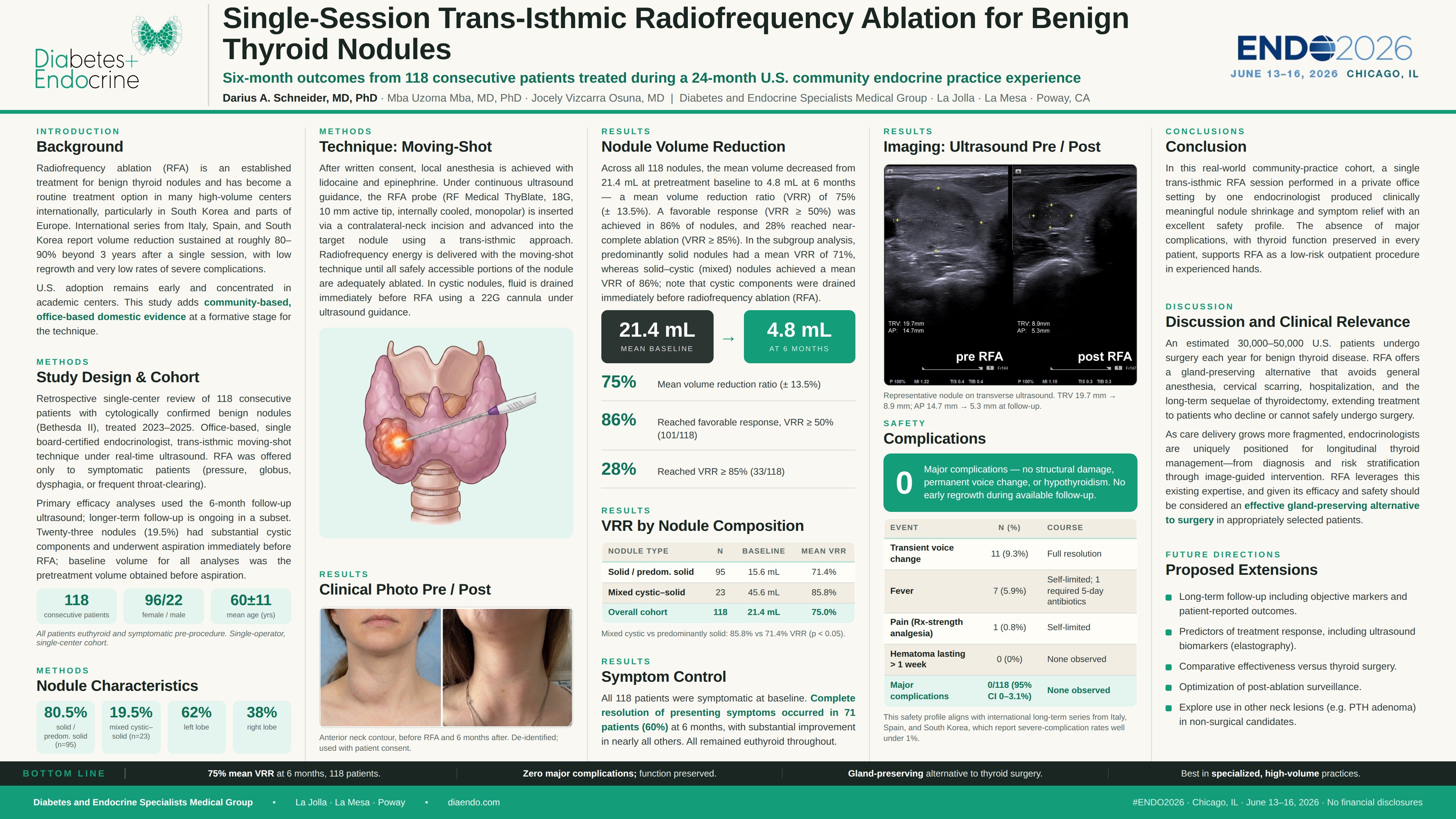
Across all 118 patients, there were no major complications — no permanent voice change, no structural damage, and no hypothyroidism caused by the procedure. The side effects that did occur were minor and resolved.
| Event | N (%) | Course |
|---|---|---|
| Transient voice change | 11 (9.3%) | Full resolution |
| Fever | 7 (5.9%) | Self-limited; 1 patient needed a 5-day course of antibiotics |
| Pain requiring prescription-strength analgesia | 1 (0.8%) | Self-limited |
| Hematoma lasting > 1 week | 0 (0%) | None observed |
| Major complications | 0 (0%) | None observed (95% CI 0–3.1%) |
This safety profile is consistent with the international long-term series from Italy, Spain, and South Korea, which report severe-complication rates well under 1%.
RFA is low-risk in experienced hands, but it is a medical procedure with real trade-offs. Here is the straight version — the things every candidate should understand before deciding.
RFA reduces a nodule’s size; it does not take it out. Treated tissue stays in place and clears gradually. Most nodules shrink substantially, but not to zero.
RFA is only for nodules confirmed benign on biopsy. It is not a treatment for thyroid cancer or for nodules with suspicious or indeterminate cytology.
A minority of nodules can partially regrow over years and may need a repeat session. Long-term follow-up with ultrasound is part of the plan.
Pain, a sensation of warmth, or a short-lived voice change can occur. In our cohort these resolved, but they are real and worth expecting.
RFA outcomes are operator-dependent. Volume reduction and safety are best in experienced, high-volume hands — technique and judgment matter.
Location, size, composition, and your overall thyroid picture all affect whether RFA is the right choice. Some nodules are better served by surgery or surveillance.
Ethanol ablation uses high-resolution ultrasound to guide a small amount of ethanol directly into a thyroid nodule or cyst, producing a controlled response that selectively destroys the targeted tissue.
It is particularly suited to cystic, fluid-filled nodules, which are very rarely cancerous. These cysts can often be drained with a needle, but fluid frequently re-accumulates and the nodule returns. Ethanol ablation treats the lining that produces the fluid, so the problem is addressed rather than temporarily relieved — making it a durable alternative to repeated aspiration when a cyst is large or causing symptoms.
Like RFA, ethanol ablation is performed in the office under local anesthesia with real-time ultrasound guidance, with no incision and no hospital stay. For patients with a predominantly cystic nodule, it is worth discussing non-surgical options before proceeding to an operation.
Surgery remains the standard treatment for thyroid cancer. In carefully selected patients, ultrasound-guided ablation can be considered as a minimally invasive, off-label option.
The strongest evidence is in two settings: small, low-risk papillary microcarcinomas in patients who are not surgical candidates or decline surgery, and locally recurrent cancer in the neck after prior surgery, where re-operation is difficult. These are off-label applications — not FDA-cleared indications — appropriate only after precise localization, biopsy confirmation, and a multidisciplinary discussion with head and neck surgery. We are glad to review your imaging and pathology and tell you honestly whether ablation is reasonable for your situation.
The same image-guided techniques used for thyroid nodules — radiofrequency ablation and ethanol ablation — can, in carefully selected cases, be applied to other neck lesions. The most established of these is the parathyroid adenoma.
A parathyroid adenoma is a small, benign growth of a parathyroid gland that causes primary hyperparathyroidism. Surgery — parathyroidectomy — remains the standard, definitive treatment. But some patients are not candidates for an operation, whether because of other medical conditions, prior neck surgery, anesthesia risk, or personal choice. For these patients, ultrasound-guided RFA or ethanol ablation of a localized adenoma may be considered as an off-label, minimally invasive option intended to reduce parathyroid hormone production and its effects.
These are off-label applications: they are not FDA-cleared indications, the evidence base is more limited than for thyroid nodule ablation, and they are appropriate only after careful evaluation and a multidisciplinary discussion. Candidacy depends on precise localization of the adenoma, its relationship to surrounding structures, and confirmation that ablation is a reasonable choice for that individual. Other selected benign neck lesions may also be evaluated for ablation on a case-by-case basis.
If you have a parathyroid adenoma or another neck lesion and are not a candidate for surgery — or simply want to understand whether a non-surgical approach is reasonable for you — we are glad to review your imaging and laboratory results and talk it through.
Ultrasound of the nodule and review of your biopsy to confirm it’s benign and a good candidate for RFA.
A single outpatient session under local anesthesia. Most people are in and out the same day.
Quick return to normal activity. Mild soreness or a brief voice change can occur and settles.
Follow-up ultrasound tracks shrinkage over the following months, with longer-term surveillance as needed.
We work with most major insurances, including Medicare. Because coverage depends on your plan and your nodule, we’ll give you a clear, personalized quote before anything is scheduled — just call.
Without insurance, thyroid RFA is $4,500 — performed entirely in our office, with no separate hospital, surgical-center, or anesthesia fees. Call the office at (858) 622-7200 and we will confirm your coverage and out-of-pocket cost.
We work with most major insurance plans, including Medicare. Coverage for thyroid RFA depends on your specific plan and clinical situation, so the most reliable way to know your cost is to ask us directly.
Call the office for a personalized quote, or request a consultation and we’ll review your coverage with you.
The first step is a thyroid nodule evaluation to confirm whether RFA is right for you. We see patients across San Diego and welcome referrals from other physicians.
Prospective patients and referring physicians can reach us directly using the details below.
Send us the patient’s ultrasound and biopsy result and we’ll coordinate the consultation. We keep referring physicians informed throughout treatment and follow-up.
Email a referralThyroid RFA and ethanol ablation are performed at our La Jolla office, on the Scripps Memorial campus.
The physicians of Diabetes and Endocrine Specialists Medical Group.